---
title: Introducing the Foundations of Numeracy
description: A practical framework that distills decades of research into a clear, shared understanding of what strong elementary math learning looks like
image: https://blog.powermylearning.org/hubfs/PowerMyLearning_Foundations%20of%20Numeracy%20Press%20Release.png
---
[Skip to content](https://blog.powermylearning.org/introducing-the-foundations-of-numeracy#main-content)
[](https://powermylearning.org/)
- [Home ](https://powermylearning.org/)
- [About ](https://powermylearning.org/about/)
- [MathVoice ](https://powermylearning.org/mathvoice/)
- [Impact ](https://powermylearning.org/impact/)
- [Why PowerMyLearning ](https://powermylearning.org/why-powermylearning/)
- [Content Hub ](https://blog.powermylearning.org)
- [Contact Us ](https://powermylearning.org/contact-us/)
- [Donate ](https://toolkits.powermylearning.org/donate)
This is a search field with an auto-suggest feature attached.
- There are no suggestions because the search field is empty.
# Introducing the Foundations of Numeracy
by [PowerMyLearning](https://blog.powermylearning.org/author/powermylearning) on February 4, 2026
[Press Releases](https://blog.powermylearning.org/tag/press-releases)
# PowerMyLearning launches the Foundations of Numeracy to clarify what young students need to thrive in math
*A practical framework that distills decades of research into a clear, shared understanding of what strong elementary math learning looks like*
**NEW YORK****, ****Feb. 4, 2026**: PowerMyLearning announced the launch of the [Foundations of Numeracy](https://powermylearning.org/foundations-of-numeracy/), an evidence-informed framework developed with leading math researchers and practitioners to bring long-needed clarity and alignment to PK–5 math learning nationwide. The framework synthesizes decades of research into a practical, accessible structure that will help districts, educators, and policymakers improve math outcomes for all students.
Across the country, states and districts are prioritizing math across prekindergarten through grade 5 as student performance falters. Yet despite growing attention, the field lacks a shared definition of what “numeracy” truly means in the elementary grades.
“Educators and policymakers are being asked to improve math outcomes without a common reference point for what numeracy actually requires,” said Arun Ramanathan, CEO, PowerMyLearning. “The Foundations of Numeracy brings coherence to that challenge by offering a practical roadmap on the essential building blocks every child needs to enter middle school with a strong foundation in mathematics.”
#### **A Balanced, Comprehensive Framework**
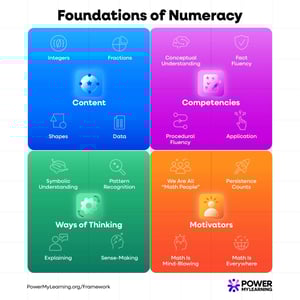
Rather than advancing a single instructional approach, the framework integrates insights from **over 200 studies** across disciplines. The *Foundations of Numeracy* identifies four essential cornerstones of PK–5 math learning:
1. **Content**: The core mathematical ideas that all future learning builds upon.
2. **Competencies**: The balanced skills students need to use math meaningfully.
3. **Ways of Thinking**: The cognitive processes that support reasoning and problem-solving.
4. **Motivators**: The beliefs and mindsets that foster engagement and persistence.
Across these four cornerstones are 16 essential “building blocks,” which are the skills students need to thrive by the time they enter middle school.
“Educators are tasked with meeting the math needs of all students, and many students experience difficulty with math. The Foundations of Numeracy could be used as a tool to help educators think practically about essential math skills for students so educators can provide evidence-based instruction for students,” said Sarah R. Powell, Ph.D., The University of Texas at Austin.
“The Foundations of Numeracy expands the definition of early math beyond procedures. It invites students into a space for deep thinking, creativity, and exploration. By illuminating the importance of reasoning and mindset, the framework supports lasting understanding and helps students develop a strong, positive mathematics identity,” said Dr. Jo Boaler, Stanford University; cofounder of youcubed and Struggly.
#### **Addressing an Urgent National Challenge**
Research shows that elementary math proficiency is one of the strongest predictors of later school achievement, even more so than reading. Students who develop conceptual understanding, fluency, and reasoning skills by grade five are better prepared for advanced mathematics, better positioned for long-term academic success, and more likely to access future opportunities.
“Numeracy matters as much as literacy. Families and educators know this. The goal in creating the Foundations of Numeracy was to synthesize the vast research base into a memorable, practical framework that could help anyone in the education field improve elementary math outcomes for students,” said Gloria Lee, Stanford Graduate School of Education, lead author of the Foundations of Numeracy.
Much like Scarborough’s Reading Rope helped teachers align around the essential components of literacy, the Foundations of Numeracy offers a unifying structure to clarify what strong numeracy development requires. By offering a common language and actionable structure, the framework aims to align district leaders, teachers, and policymakers on what’s best for students.
#### **About PowerMyLearning**
PowerMyLearning is a national nonprofit dedicated to improving math outcomes for PK–5 students. For over 25 years, we’ve partnered with schools and districts—especially those serving multilingual learners and historically underserved communities—with evidence-based programs, services, and digital solutions proven to boost math achievement. To learn more, visit: [www.PowerMyLearning.org](http://www.powermylearning.org/).
###
### Additional Resources
Download the complete *Foundations of Numeracy* framework at [PowerMyLearning.org/Framework](https://powermylearning.org/foundations-of-numeracy/). Licensed under the Creative Commons CC BY 4.0 International License, the framework may be shared and adapted with attribution to PowerMyLearning.
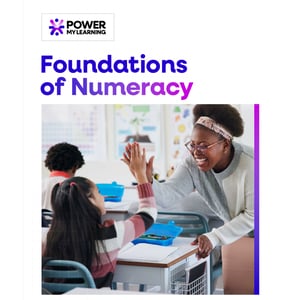
### Explore the Framework
Discover the essential skills students need to build strong numeracy before middle school.
[ Download ](https://powermylearning.org/foundations-of-numeracy/)
### Spread the Word
Share the framework with your networks. Access ready-to-use posts, graphics, and messaging.
[ Social Toolkit ](https://toolkits.powermylearning.org/social)
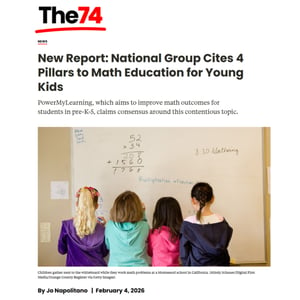
### Recent News Coverage
National education publication The 74 highlights the framework and its four cornerstones.
[ Read Article ](https://www.the74million.org/article/new-report-national-group-cites-4-pillars-to-math-education-for-young-kids/)
Spread the word:
[Share this blog post on Twitter ](https://twitter.com/intent/tweet?text=I+found+this+interesting+blog+post&url=https://blog.powermylearning.org/introducing-the-foundations-of-numeracy) [Share this blog post on Facebook ](http://www.facebook.com/share.php?u=https://blog.powermylearning.org/introducing-the-foundations-of-numeracy) [Share this blog post on LinkedIn ](http://www.linkedin.com/shareArticle?mini=true&url=https://blog.powermylearning.org/introducing-the-foundations-of-numeracy)
## Related Articles
[ ](https://blog.powermylearning.org/instructional-coaching-impact-report)
### [Relationship-driven Instructional Coaching: PowerMyLearning’s Impact in LAUSD](https://blog.powermylearning.org/instructional-coaching-impact-report)
This study examines the impact of PowerMyLearning’s teacher instructional coaching program on Los...
by [PowerMyLearning](https://blog.powermylearning.org/author/powermylearning)
[ ](https://blog.powermylearning.org/three-things-weve-learned-about-student-ownership-of-learning)
### [Three things we’ve learned about student ownership of learning](https://blog.powermylearning.org/three-things-weve-learned-about-student-ownership-of-learning)
The promise of instilling *ownership of learning* in students has been proffered for decades. Ask...
by [Elisabeth Stock](https://blog.powermylearning.org/author/elisabeth-stock)
[.png) ](https://blog.powermylearning.org/npr-teaching-matters)
### [NPR's Teaching Matters Podcast: The Story of SEL at Jeanne R. Meadows Elementary](https://blog.powermylearning.org/npr-teaching-matters)
by [PowerMyLearning](https://blog.powermylearning.org/author/powermylearning)
[](https://powermylearning.org/)
- [Home](https://powermylearning.org/)
- [About](https://powermylearning.org/about/)
- [Why PowerMyLearning](https://powermylearning.org/why-powermylearning/)
- [MathVoice](https://powermylearning.org/mathvoice/)
- [Impact](https://powermylearning.org/impact/)
- [Content Hub](https://blog.powermylearning.org)
- [Contact Us](https://powermylearning.org/contact-us/)
- [Home](https://powermylearning.org/)
- [About](https://powermylearning.org/about/)
- [Why PowerMyLearning](https://powermylearning.org/why-powermylearning/)
- [MathVoice](https://powermylearning.org/mathvoice/)
- [Impact](https://powermylearning.org/impact/)
- [Content Hub](https://blog.powermylearning.org)
- [Contact Us](https://powermylearning.org/contact-us/)
---
© PowerMyLearning. All rights reserved.
- [Terms and Conditions](https://powermylearning.org/terms-and-conditions/)
- [Privacy Policy](https://powermylearning.org/privacy-policy/)